
THINKDROP 47: You Make Better Burgers. McDonald's Makes More Money.

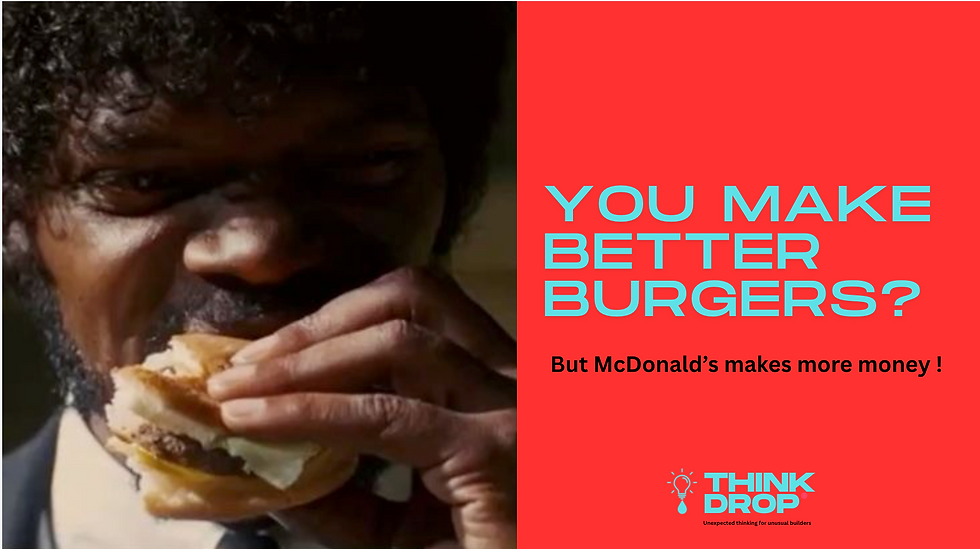
Quality nobody can see is quality nobody pays for.
Let me get one thing out of the way first. I think McDonald's food is bad. Not "guilty pleasure" bad. Bad. I've watched enough documentaries on what happens to their fries, their patties and their buns before they reach the tray that I had to stop watching. OMG.
And yet. Every time I walk past one, it's full.
Two streets away there's usually a place that makes a burger ten times better. Real beef, real bread, a cook who actually cares. On a Tuesday night it's half empty, and the owner is convinced his customers are idiots.
Same street, same Tuesday, and one of them makes more money than the other will ever see.
They're not idiots. They bought the one thing he isn't selling.
(Yes, another burger. In THINKDROP 33 the burger was a magnet. This time it's a mirror.)
Because this is not a restaurant story. Swap the burger for anything you like. The consultant whose method is sharper than the Big Four's, losing the pitch to a logo. The yoga studio with the best teachers in town, half empty next to a chain with a nice app. The craft spirits brand that wins blind tastings and loses the shelf. The software that does the job better and still loses to the one everybody already knows.
Better product. Smaller business. And a quiet resentment toward a market that "doesn't get it."
The market gets it fine. It just can't see what you're so proud of.
Pierre Stanghellini
Founder @ HARi.wtf
1. Your Customer Can't Taste Before Paying
Every purchase is a bet. The customer pays first and finds out later. For a burger, the risk is ten dollars. For a gym membership, it's a year of direct debits. For a bottle on a bar's back shelf, it's the owner's margin. For a consultant, an agency or a software contract, it's months of budget and the buyer's own reputation inside their company.
So what does the customer actually buy? Not quality. They buy their best guess about quality, made before they've experienced any of it.
That's where the excellent but invisible business loses. Your quality shows up after the contract is signed. At the moment of decision, it doesn't exist. What exists is your website, your proposal, the first call, and what someone said about you over lunch. As far as the buyer knows, that's the whole product.
Quality that only appears after the sale doesn't help you make the sale.
Try this: Ask your last 3 clients one question: "What made you pick us before we'd done any work together?" Write down their exact words. That's what you're really selling. It's usually not what's on your homepage.
2. McDonald's Doesn't Sell Burgers. It Sells Zero Surprise.
Nobody walks into McDonald's expecting a great meal. They walk in knowing exactly what they'll get, how long it'll take, what it'll cost, and that it will taste the same in Hong Kong, in Paris or in an airport at 2am.
That's the product. Not the burger. The absence of risk.
The small place with the better burger offers something else. Maybe it's amazing. Maybe the chef is off tonight. Maybe it takes 25 minutes. Maybe the price went up since last time. For a hungry person with no time, "maybe amazing" loses to "definitely fine" almost every time.
Your business works exactly the same way. The procurement manager picking the big consultancy, the bar owner listing the brand everyone already orders, the HR director choosing the gym chain for the corporate plan: none of them is asking "who is the best?" They're asking "who is least likely to embarrass me?"
Predictable beats excellent when the buyer can't tell the difference in advance.
Try this: List the three things a new client worries about before hiring you: delays, budget, being ignored after signing. For each one, write down what you do to remove that worry. If a line stays blank, that's where you're losing deals.
3. Autotune Is Not the Answer
So the tempting fix is to fake it. New logo. Slick website. Stock photos of people laughing at laptops. Testimonials polished until they sound like nobody. The autotune version of your business.
It works. Once. It gets you the first meeting, maybe the first sale. Then the client meets the real thing, and the gap between what you showed and what you deliver becomes the story they tell about you.
Appearance without substance isn't marketing. It's a loan. You pay it back with interest the day the client finds out.
Think about music. Autotune makes everyone sound clean, and everyone sound the same. The artists people stay loyal to for thirty years are the ones you recognise in two notes, cracks included. The substance is the brand. The job is not to hide it. The job is to make sure people can hear it.
Polish gets the first sale. Proof gets the second.
Try this: Open your website or your main sales deck. Highlight every sentence a competitor could copy word for word: "tailored solutions", "passionate team", "results-driven". Delete half of them this week and replace each one with a specific fact only you could say.
4. Make the Substance Legible
The real fix sits between the two. Not fake quality. Visible quality. You don't need to look better than you are. You need to make what you are readable before the sale.
Concretely, that means showing instead of promising. A before and after with real numbers. A one-page description of exactly how you work, week by week. A case study where the client is named and the result is measurable. A guarantee on the one thing you know you always deliver. A sample of the work instead of a description of it.
The better burger place could do it tomorrow. Open the kitchen. Put the butcher's name on the menu. Hand out a taste at the door.
Same logic everywhere else. The yoga studio films a real class instead of a sunset pose. The spirits brand puts its bartenders in front of the bottle, not a model. The consultant publishes the actual framework instead of "a proven methodology". The software lets people try it with their own data instead of watching a demo video. Nothing fake, nothing new. Just the quality that already exists, made visible.
Don't dress up the substance. Turn the lights on.
Try this: Write one sentence that starts with "Every client gets..." and ends with something concrete and checkable. Not "great service". Something like "a written plan within 5 days of signing". If you can write it, put it on your site this week. If you can't, that's the real problem.
5. Consistency Is the Real Product
Here's where the McDonald's lesson actually lives, and it's not in the food. It's in the repetition.
Your best client experience probably exists. It's the class taught by your best instructor, the account handled by your best salesperson, the project run when you were rested and focused. The problem is that it depends on the right person having a good week. The client who signs in a good week gets the excellent version. The client who signs in a bad week gets a different company.
That's not a quality problem. It's a system problem. McDonald's understood a long time ago that a mediocre product delivered identically beats an excellent product delivered randomly. You don't have to accept the mediocre part. You do have to steal the identical part.
Checklists. Templates. A follow-up that happens whether you remember it or not. A client record that tells you what happened last time before you pick up the phone. Boring stuff. It's what turns "he's great when he's on" into "they're great."
Excellent once is a talent. Excellent every time is a business.
Try this: Pick the moment in your client journey where quality varies the most: onboarding, follow-up, reporting. Write it down as a 5-step checklist and use it with every client for the next 30 days. No exceptions, including the clients you like.
5-Point Recap
The buyer decides before tasting. Quality that only appears after the sale doesn't make the sale.
Zero surprise is a product. Remove the worries before you add the features.
Autotune is a loan. Polish without substance gets repaid with interest.
Turn the lights on. Make your existing quality visible: proof, process, specifics.
Steal the repetition, not the recipe. Excellent every time is what scales.
Food for Thought
I've lost deals to people who were not as good as me. So has everyone reading this. For years my reaction was the burger guy's reaction. The client didn't get it. The other side was all packaging. The market rewards the wrong things.
It took me an embarrassingly long time to admit that the client had made a rational choice with the information I'd given them. Which was almost nothing. I was counting on the quality to speak for itself. Quality doesn't speak. It sits in the kitchen, waiting to be discovered by people who already decided to eat somewhere else.
I still think McDonald's food is bad. I'm not changing my mind on that, and I'm not asking you to make worse burgers. I'm asking for the opposite. Keep the good beef. Keep the voice with the cracks in it. Then do the one thing McDonald's is genuinely brilliant at: make sure every customer knows what they'll get before they walk in, and gets it every single time.
A great product with a system behind it is the one thing they will never be able to copy.
So here's the question for this week. If a stranger had 30 seconds to judge your business, what would they see? And is it the thing you're actually good at?
Pierre Stanghellini
→ Let's connect, drop me a line directly at pierre@hari.wtf.
YOU LIKED IT ?? Share with friends and let's expand our community!
Once we reach 1,000 followers on LinkedIn, I'll launch the THINKDROP Conference! It's going to be amazing!
SUBSCRIBE TO THE NEWSLETTER ON LINKEDIN!
Cas Pratique
Section 5 is where most small businesses break. The excellent version of their service exists, but it lives in the founder's head. Who needs a follow-up, who went quiet, what was promised on the last call: it's spread across a phone, an inbox, a spreadsheet and memory. So consistency depends on how good the week was.
That's the gap HARi CRM closes. One place where every client sits, with what they bought, when you last spoke, and when they went quiet. You stop relying on remembering, and the client who signs in a bad week gets the same experience as the one who signed in a good week.
If your quality is real but your clients experience it randomly, that's not a talent problem. That's a visibility problem, and it's fixable this week.
→ Book a HARi CRM demo and we'll look at your client journey together. Contact me directly: pierre@hari.wtf
FAQ: Better Product, Fewer Clients
Why do competitors with a worse product win more clients?
Because clients decide before they experience your quality. At the moment of choosing, they compare what they can see: proof, clarity, predictability, reputation. A competitor with an average product and a clear, reassuring offer will often beat an excellent product that only reveals itself after the contract is signed.
How can I show the quality of my service before a client buys?
Make it legible instead of promising it. Use named case studies with measurable results, a short description of exactly how you work, a concrete commitment such as "a written plan within 5 days", and samples of real work. Replace generic claims that any competitor could copy with specific facts only you can state.
Is investing in branding and design a waste of money?
No, but polish is not a substitute for substance. A better look can win the first meeting, but if the delivery doesn't match, the gap becomes your reputation. Invest first in making your real quality visible and consistent, then use design to amplify it, not to hide what's missing.
About the Creator
Pierre Stanghellini is a creative strategist, systems thinker, and curator of mental rabbit holes. He created Thinkdrop Weekly to feed the brains that don't want the same old Business advice. If you're building something bold, beautiful, or strange, this is your corner of the internet.
About HARi.wtf
HARi.wtf is a creative strategy studio for businesses that hate business-as-usual. Born in Hong Kong, in 2017, we work with restless founders, operators, and teams who'd rather break things thoughtfully than grow them blandly. We don't do generic decks or bloated strategies; we build clarity, guts, and traction.
From street-level restaurants to global brands, from Asia to Europe, we help shape ideas that move fast when it matters, and slow when it counts.
Explore more at HARi.wtf


Comments