
THINKDROP 43: They Didn't Invent Anything. They Just Read the Bible.

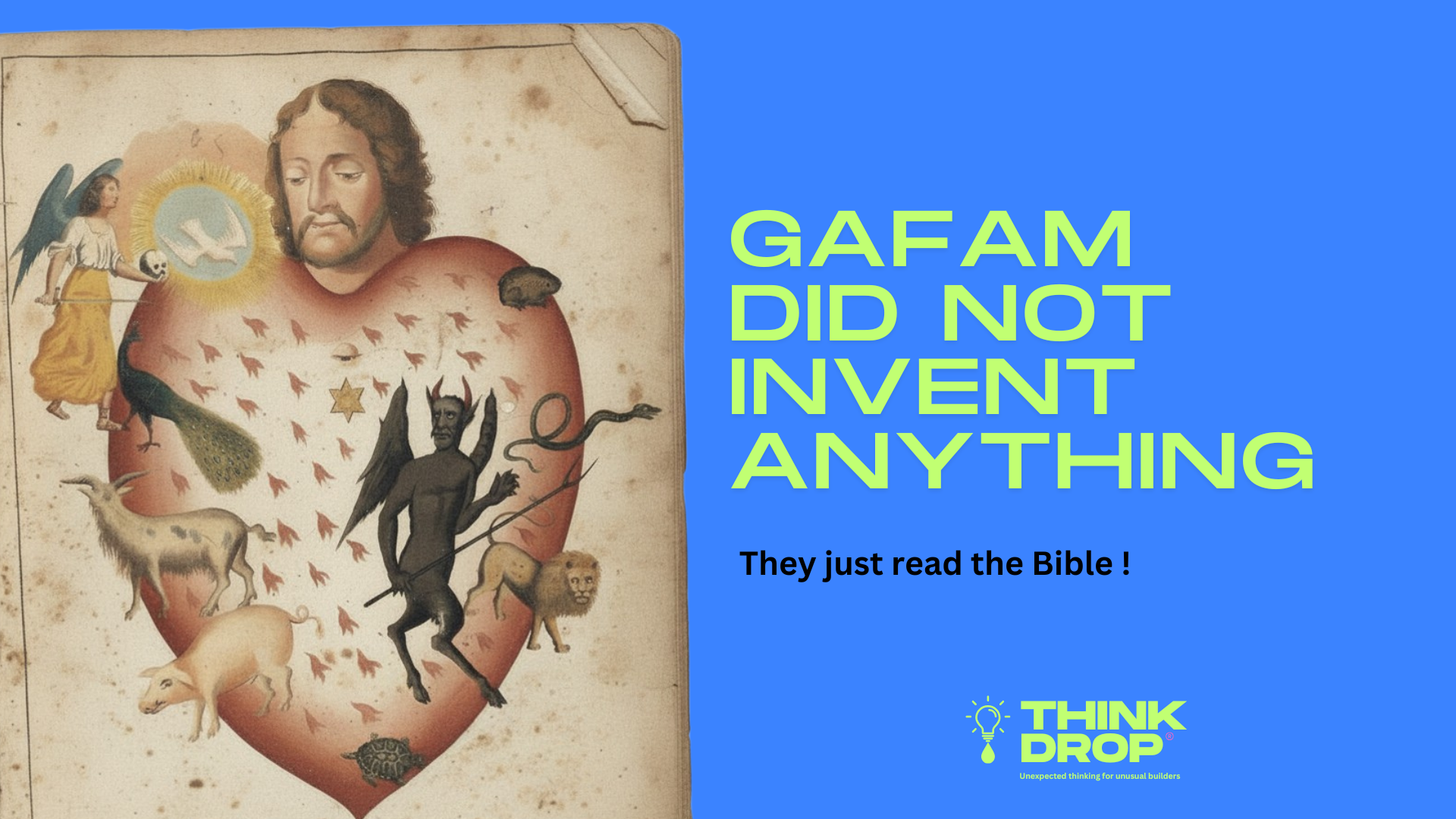
A few weeks ago, I came across an idea while scrolling online. Someone had mapped big tech platforms to the 7 deadly sins.
Simple concept. Clean execution. Almost right.
So I updated the mapping, swapped a few examples, added a platform that covers two sins simultaneously, and wrote my own version. Consider this the street-tested edition.
In the 4th century, a monk named Evagrius Ponticus catalogued what he called the eight logismoi: universal patterns of human weakness. The Catholic Church refined them to seven and distributed the framework for 1,500 years.
Not as a moral lecture. As a map of predictable human vulnerabilities.
The world's biggest tech platforms read that map. And built trillion-dollar businesses from it. Each one anchored to a specific register of human weakness, selected not by accident but by data.
Today, exceptionally: 7 sections. One per sin.
Because this one required the full set.
Pierre Stanghellini
Founder @ HARi.wtf
1. PRIDE (Orgueil): Facebook / Instagram
Pride is the most social of all sins. Humans are hardwired for status and validation. Facebook and Instagram gave that performance a global stage, a quantified score (the like), and an infinite audience. Every post is a declaration: look at who I am. The like is ego currency. The follower count is a status update that never stops moving.
Pride scales because everyone has an ego. There is no demographic that doesn't want to be seen.
TRY THIS: Before posting anything on social media this week, ask yourself: am I sharing this to give value, or to be seen? No judgment. Just notice the honest answer.
2. ENVY (Envie): Artificial Intelligence
AI creates envy by showing you the gap. You spend three hours on a report. The AI writes a decent version in 45 seconds. You want the result without the road. That's envy: desiring the fruit without the tree. AI is the first tool in history that makes you envious of a machine.
Envy is the engine of adoption. Nobody updates their software out of joy. They update because they're afraid of falling behind.
TRY THIS: This week, notice every time you feel urgency around AI adoption. Is it genuine curiosity, or fear that everyone else is ahead? Write it down. The distinction matters.
3. LUST (Luxure): Tinder
Tinder didn't invent sexual desire. They gamified it. The swipe is a variable reward mechanism, the same dopamine loop as a slot machine, applied to human attraction. Tinder earns more money when you don't find someone. Retention requires dissatisfaction. It's lust without resolution, engineered at product level.
The platform monetizes the desire to desire, not the desire to arrive.
TRY THIS: Think about one product you use daily. Is its business model aligned with you achieving your goal, or with you staying in a state of almost? The answer tells you who the product was actually designed for.
4. GREED (Avarice): Amazon
Between desire and acquisition, there used to be friction. Friction was the natural brake on greed. Amazon's entire architecture is the systematic destruction of that friction. One-click. Prime. Same-day delivery. Every feature shrinks the distance between impulse and purchase to zero.
They didn't make people greedier. They removed every obstacle between greed and its object.
TRY THIS: For 7 days, apply a 24-hour rule before any non-essential purchase. Not as a moral exercise. As data: how many were impulse vs. genuine need?
5. GLUTTONY (Gourmandise): TikTok / YouTube
Gluttony is the inability to stop when you've had enough. Infinite scroll was engineered to eliminate the concept of enough. The algorithm learns your exact appetite and serves it on a loop. Autoplay is the restaurant that refills your plate before you notice you're full.
The platform manages your appetite by ensuring it's never satisfied.
TRY THIS: This week, set one intentional stopping point before opening YouTube or TikTok. When you hit it, stop. Notice the physical resistance. That resistance is the product working as designed.
6. SLOTH (Paresse): Artificial Intelligence (again)
Yes, AI appears twice. Impressive or alarming. Possibly both. Envy is wanting the result without the road. Sloth is not wanting to think at all. AI offers to think for you. Write your emails. Form your opinions. Summarize the book so you don't have to read it. The cognitive outsourcing is total. Except muscles atrophy when they don't work. And so do minds.
The promise of AI is efficiency. The risk: efficiency becomes the reason to stop developing the capacity that made you valuable in the first place.
TRY THIS: Pick one task you'd normally hand to AI and do it yourself first. Fully. Then compare. Not to prove AI wrong. To verify you still have the muscle.
7. WRATH (Colère): Twitter / X
A 2018 MIT study found that false news spreads six times faster than accurate news on Twitter, primarily because outrage shares more than satisfaction. Twitter didn't design around anger. They designed around engagement, and engagement pointed to anger. Nuance doesn't travel in 280 characters. Fury does.
The feed is not a conversation. It's a coliseum. The algorithm schedules the fights.
TRY THIS: Spend 10 minutes on Twitter/X this week. Count: posts designed to make you angry vs. posts designed to make you think. Record the ratio.
Then decide how much time the platform deserves.
7-Point Recap (yes, seven — exceptional article, exceptional recap)
Pride (Facebook/Instagram): global stage + quantified ego score. The goalpost moves permanently.
Envy (AI): the first tool that makes you envious of a machine. It shows the gap and monetizes your urgency to close it.
Lust (Tinder): desire without resolution. The business earns more when you don't find what you're looking for.
Greed (Amazon): friction was the natural brake on impulse. Amazon systematically destroyed every brake.
Gluttony (TikTok/YouTube): the appetite is managed by ensuring it's never satisfied.
Sloth (AI again): total cognitive outsourcing. The muscle you stop using is the one that made you irreplaceable.
Wrath (Twitter/X): anger is the most viral emotion. The algorithm didn't choose fury. Engagement metrics did.
Food for Thought
I'm not writing this as a moral lecture. Delete your apps or don't. Evagrius tried the monastery route. With limited success.
These companies didn't invent new human needs. They identified ancient vulnerabilities and built the most efficient delivery mechanisms in history. The 7 deadly sins were mapped 1,500 years ago. The framework was always there. They just had better distribution.
I've made a clear choice: I won't build my business on these mechanisms. Not because I'm holding a moral flag. Because a business anchored to physiological dependency accumulates negative societal credit. And eventually, that bill gets paid in regulation, in trust, in talent that doesn't want to work for you. I'd rather build slower on something that doesn't require making people weaker to make the numbers work.
But when you build something, when you grow something, when you decide what kind of business you want to run: which register are you choosing to anchor to?
The Bible had the blueprint. The GAFA had the engineers.
You have the choice.
Pierre Stanghellini
Let's connect, drop me a line directly at pierre@hari.wtf .
YOU LIKED IT ??
Share with friends and let's expand our community!
Once we reach 1,000 followers on LinkedIn, I'll launch the THINKDROP Conference! It's going to be amazing!
SUBSCRIBE TO THE NEWSLETTER ON LINKEDIN!
About the Creator
Pierre Stanghellini is a creative strategist, systems thinker, and curator of mental rabbit holes. He created Thinkdrop Weekly to feed the brains that don't want the same old Business advice. If you're building something bold, beautiful, or strange, this is your corner of the internet.
Connect on LinkedIn
About HARi.wtf
HARi.wtf is a creative strategy studio for businesses that hate business-as-usual. Born in Hong Kong, in 2017, we work with restless founders, operators, and teams who'd rather break things thoughtfully than grow them blandly. We don't do generic decks or bloated strategies; we build clarity, guts, and traction.
From street-level restaurants to global brands, from Asia to Europe, we help shape ideas that move fast when it matters, and slow when it counts.
Explore more at HARi.wtf


Comments